Namespaces | |
| namespace | detail |
Functions | |
| constexpr void | hhc_32bit_encode_padded (uint32_t input, char *output_string) |
| Encode a 32-bit integer into a 6-character string. | |
| constexpr void | hhc_unpad_string (char *output_string) |
| Unpad a string by removing the leading '-' padding characters and moving the significant content to the beginning. | |
| constexpr void | hhc_32bit_encode_unpadded (uint32_t input, char *output_string) |
| Encode a 32-bit integer into a 6-character string without padding. | |
| constexpr uint32_t | hhc_32bit_decode_unsafe (const char *input_string) |
| Decode a 32-bit integer from a 6-character string. | |
| constexpr void | hhc_64bit_encode_padded (uint64_t input, char *output_string) |
| Encode a 64-bit integer into a 11-character string. | |
| constexpr void | hhc_64bit_encode_unpadded (uint64_t input, char *output_string) |
| Encode a 64-bit integer into a 11-character string without padding. | |
| constexpr uint64_t | hhc_64bit_decode_unsafe (const char *input_string) |
| Decode a 64-bit integer from a 11-character string. | |
| constexpr std::size_t | hhc_validate_string (const char *input_string) |
| Validate a string to ensure it is a valid HHC string. | |
| constexpr bool | hhc_bounds_check (const char *input_string, const char *max_string) |
| Check if a string is within the bounds of a maximum string. | |
| constexpr uint32_t | hhc_32bit_decode (const char *input_string) |
| Decode a 32-bit integer from a 6-character string. | |
| constexpr uint64_t | hhc_64bit_decode (const char *input_string) |
| Decode a 64-bit integer from a 11-character string. | |
| constexpr std::array< uint8_t, 256 > | make_hhc_inverse_alphabet () |
Variables | |
| constexpr uint32_t | BASE = 66 |
| constexpr std::array< char, BASE > | ALPHABET |
| constexpr uint8_t | HHC_INVALID_CHAR = 0xFF |
| constexpr auto | INVERSE_ALPHABET = make_hhc_inverse_alphabet() |
| constexpr uint32_t | BITS_PER_BYTE = 8 |
| constexpr size_t | HHC_32BIT_STRING_LENGTH = 8 |
| constexpr size_t | HHC_64BIT_STRING_LENGTH = 16 |
| constexpr size_t | HHC_32BIT_ENCODED_LENGTH = 6 |
| constexpr size_t | HHC_64BIT_ENCODED_LENGTH = 11 |
| constexpr auto | HHC_32BIT_ENCODED_MAX_STRING = "1QLCp1" |
| constexpr auto | HHC_64BIT_ENCODED_MAX_STRING = "9lH9ebONzYD" |
Function Documentation
◆ hhc_32bit_decode()
|
constexpr |
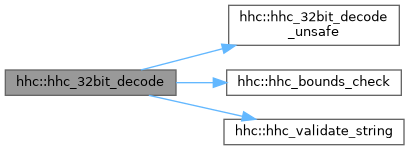
Decode a 32-bit integer from a 6-character string.
- Parameters
-
input_string The input string to decode
- Returns
- The decoded 32-bit integer
- Exceptions
-
std::invalid_argument if the string is invalid std::out_of_range if the string exceeds 32-bit bounds
Here is the call graph for this function:
◆ hhc_32bit_decode_unsafe()
|
constexpr |
Decode a 32-bit integer from a 6-character string.
- Note
- Performs no validation: non-alphabet bytes produce a garbage value (but never out-of-bounds memory access). Use hhc_32bit_decode for untrusted input.
- Parameters
-
input_string The input string to decode (must be at least HHC_32BIT_ENCODED_LENGTH bytes)
- Returns
- The decoded 32-bit integer
Here is the caller graph for this function:

◆ hhc_32bit_encode_padded()
|
constexpr |
Encode a 32-bit integer into a 6-character string.
- Note
- Writes exactly HHC_32BIT_ENCODED_LENGTH (6) bytes and does not null-terminate. Use a zero-initialized buffer of HHC_32BIT_STRING_LENGTH (8) bytes if a null-terminated result is needed.
- Parameters
-
input The 32-bit integer to encode output_string The output string to write the encoded result to
Here is the caller graph for this function:

◆ hhc_32bit_encode_unpadded()
|
constexpr |
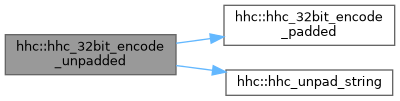
Encode a 32-bit integer into a 6-character string without padding.
- Note
- The output string is null-terminated after unpadding
- Zero encodes to a single padding character ("-")
- This version is slower because it needs to unpad the string
- Parameters
-
input The 32-bit integer to encode output_string The output string to write the encoded result to (must be at least HHC_32BIT_STRING_LENGTH bytes and null-terminated)
Here is the call graph for this function:
◆ hhc_64bit_decode()
|
constexpr |
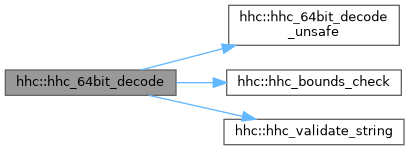
Decode a 64-bit integer from a 11-character string.
- Parameters
-
input_string The input string to decode
- Returns
- The decoded 64-bit integer
- Exceptions
-
std::invalid_argument if the string is invalid std::out_of_range if the string exceeds 64-bit bounds
Here is the call graph for this function:
◆ hhc_64bit_decode_unsafe()
|
constexpr |
Decode a 64-bit integer from a 11-character string.
- Note
- Performs no validation: non-alphabet bytes produce a garbage value (but never out-of-bounds memory access). Use hhc_64bit_decode for untrusted input.
- Parameters
-
input_string The input string to decode (must be at least HHC_64BIT_ENCODED_LENGTH bytes)
- Returns
- The decoded 64-bit integer
Here is the caller graph for this function:

◆ hhc_64bit_encode_padded()
|
constexpr |
Encode a 64-bit integer into a 11-character string.
- Note
- Writes exactly HHC_64BIT_ENCODED_LENGTH (11) bytes and does not null-terminate. Use a zero-initialized buffer of HHC_64BIT_STRING_LENGTH (16) bytes if a null-terminated result is needed.
- Parameters
-
input The 64-bit integer to encode output_string The output string to write the encoded result to
Here is the caller graph for this function:

◆ hhc_64bit_encode_unpadded()
|
constexpr |
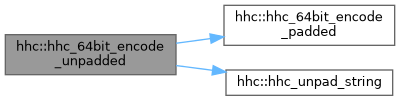
Encode a 64-bit integer into a 11-character string without padding.
- Note
- The output string is null-terminated after unpadding
- Zero encodes to a single padding character ("-")
- This version is slower because it needs to unpad the string
- Parameters
-
input The 64-bit integer to encode output_string The output string to write the encoded result to (must be at least HHC_64BIT_STRING_LENGTH bytes and null-terminated)
Here is the call graph for this function:
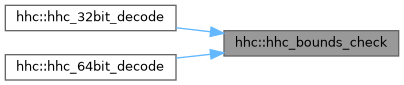
◆ hhc_bounds_check()
|
constexpr |
Check if a string is within the bounds of a maximum string.
- Parameters
-
input_string The input string to check max_string The maximum string to check against
- Returns
- True if the string is within the bounds, false otherwise
Here is the caller graph for this function:
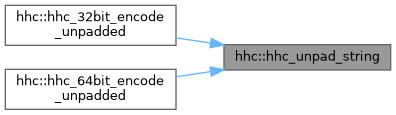
◆ hhc_unpad_string()
|
constexpr |
Unpad a string by removing the leading '-' padding characters and moving the significant content to the beginning.
- Note
- The output string is null-terminated after unpadding
- A string consisting entirely of padding represents zero and unpads to a single padding character ("-"), so the result always round-trips through decode
- Parameters
-
output_string The output string to unpad (must be null-terminated)
Here is the caller graph for this function:
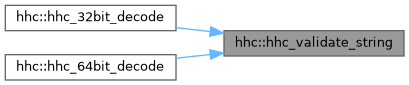
◆ hhc_validate_string()
|
constexpr |
Validate a string to ensure it is a valid HHC string.
- Note
- Validity is alphabet membership via INVERSE_ALPHABET, not an ASCII range check: the alphabet is non-contiguous, so bytes such as '/' ':' '@' '‘’ '{' fall between alphabet characters and are invalid.
- Parameters
-
input_string The input string to validate
- Returns
- The length of the valid string, 0 if the string is invalid
Here is the caller graph for this function:
◆ make_hhc_inverse_alphabet()
|
constexpr |
Variable Documentation
◆ ALPHABET
|
constexpr |
Initial value:
= {
'-', '.', '0', '1', '2', '3', '4', '5', '6', '7', '8', '9',
'A', 'B', 'C', 'D', 'E', 'F', 'G', 'H', 'I', 'J', 'K', 'L',
'M', 'N', 'O', 'P', 'Q', 'R', 'S', 'T', 'U', 'V', 'W', 'X',
'Y', 'Z', '_', 'a', 'b', 'c', 'd', 'e', 'f', 'g', 'h', 'i',
'j', 'k', 'l', 'm', 'n', 'o', 'p', 'q', 'r', 's', 't', 'u',
'v', 'w', 'x', 'y', 'z', '~'
}
◆ BASE
|
constexpr |
◆ BITS_PER_BYTE
|
constexpr |
◆ HHC_32BIT_ENCODED_LENGTH
|
constexpr |
◆ HHC_32BIT_ENCODED_MAX_STRING
|
constexpr |
◆ HHC_32BIT_STRING_LENGTH
|
constexpr |
◆ HHC_64BIT_ENCODED_LENGTH
|
constexpr |
◆ HHC_64BIT_ENCODED_MAX_STRING
|
constexpr |
◆ HHC_64BIT_STRING_LENGTH
|
constexpr |
◆ HHC_INVALID_CHAR
|
constexpr |
◆ INVERSE_ALPHABET
|
constexpr |